Friday, February 11, 2011

Most Dangerous Airports To Land

0 comments

1. Kansai International Airport

Osaka, Japan

Kansai International Airport

Land is a scarce resource in Japan, so engineers headed roughly 3 miles offshore into Osaka Bay to build this colossal structure. Work on the manmade island started in 1987, and by 1994 jumbo jets were touching down. Travelers can get from the airport to the main island of Honshu via car, railroad or even a high-speed ferry.

Kansai's artificial island is 2.5 miles long and 1.6 miles wide—so large that it's visible from space. Earthquakes, dangerous cyclones, an unstable seabed, and sabotage attempts from protestors are just some of the variables engineers were forced to account for. As impressive as the airport is, Stewart Schreckengast, a professor of aviation technology at Purdue University and a former aviation consultant with MITRE, cautions that climate change and rising sea levels pose a very real threat to the airport's existence. "When this was built, [engineers] probably didn't account for global warming," he says. "In 50 years or so, this might be underwater."

2. Gibraltar Airport

Gibraltar

Gibraltar Airport

Between Morocco and Spain sits the tiny British territory of Gibraltar. Construction of the airport dates back to World War II, and it continues to serve as a base for the United Kingdom's Royal Air Force, though commercial flights land on a daily basis.

Winston Churchill Avenue, Gibraltar's busiest road, cuts directly across the runway. Railroad-style crossing gates hold cars back every time a plane lands or departs. "There's essentially a mountain on one side of the island and a town on the other," Schreckengast says. "The runway goes from side to side on the island because it's the only flat space there, so it's the best they can do. It's a fairly safe operation as far as keeping people away," he says, "It just happens to be the best place to land, so sometimes it's a road and sometimes it's a runway."

3. Madeira International Airport

Madeira, Portugal

Madeira International Airport

Madeira is a small island far off the coast of Portugal, which makes an airport that is capable of landing commercial-size aircraft vital to its development. This airport's original runway was only about 5000 feet long, posing a huge risk to even the most experienced pilots and limiting imports and tourism.

Engineers extended the runway to more than 9000 feet by building a massive girder bridge atop about 200 pillars. The bridge, which itself is over 3000 feet long and 590 feet wide, is strong enough to handle the weight of 747s and similar jets. In 2004, the International Association for Bridge and Structural Engineering selected the expansion project for its Outstanding Structure Award, noting that the design and construction was both "sensitive to environmental and aesthetic considerations."

4. Don Mueang International Airport

Bangkok, Thailand

Don Mueang International Airport

From a distance Don Mueang International looks like any other midsize airport. However, smack-dab in the middle of the two runways is an 18-hole golf course.

Schreckengast, who has worked on consulting projects at this airport, says one of the major problems is that the only taxiways were located at the end of the runways. "We recommended that they build an additional taxiway in the middle, from side to side, and they said ‘absolutely not, that will take out a green and one fairway.'" The airport and the course were originally an all-military operation, but have since opened up to commercial traffic. Security threats, however, have limited the public's access to the greens.

5. Ice Runway

Antarctica

Ice Runway

The Ice Runway is one of three major airstrips used to haul supplies and researchers to Antarctica's McMurdo Station. As its name implies, there are no paved runways here—just long stretches of ice and snow that are meticulously groomed.

There is no shortage of space on the Ice Runway, so super-size aircraft like the C-130 Hercules and the C-17 Globemaster III can land with relative ease. The real challenge is making sure that the weight of the aircraft and cargo doesn't bust the ice or get the plane stuck in soft snow. As the ice of the runway begins to break up, planes are redirected to Pegasus Field or Williams Field, the two other airstrips servicing the continent.

6. Congonhas Airport

Sao Paulo, Brazil
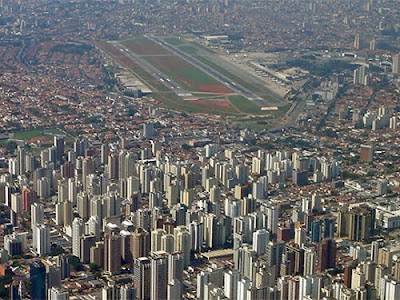
Congonhas Airport

Most major cities have an airport, but rarely are they built just 5 miles from the city center, especially in metropolises like Sao Paulo. Congonhas' close proximity to downtown can be attributed in part to the fact that it was completed in 1936, with the city experiencing rapid development in the following decades.

While having an airport only 5 miles from the city center may be a convenience for commuters, it places a strain on both pilots and air traffic control crews. "It becomes a challenge in terms of safety to just get the plane in there," Schreckengast says. "Then you throw on noise restrictions and these terribly awkward arrival and departure routes that are needed to minimize your noise-print and it becomes quite challenging for pilots." Fortunately, Sao Paulo's many high-rise buildings are far enough away from the airport that they aren't an immediate obstacle for pilots landing or taking off.

7. Courchevel International Airport

Courchevel, France
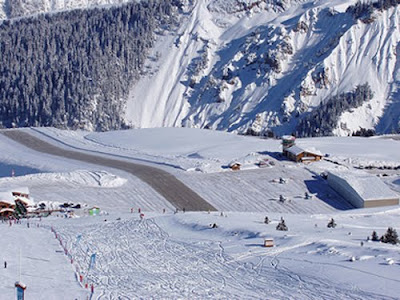
Courchevel International Airport

Getting to the iconic ski resort of Courchevel requires navigating the formidable French Alps before making a hair-raising landing at Courchevel International Airport. The runway is about 1700 feet long, but the real surprise is the large hill toward the middle of the strip.

"You take off downhill and you land going uphill," Schreckengast says. He adds that the hill, which has an 18.5 percent grade, is so steep that small planes could probably gain enough momentum rolling down it with no engines to safely glide off the edge. Landing at Courchevel is obviously no easy task, so pilots are required to obtain certification before attempting to conquer the dangerous runway.

8. Princess Juliana International Airport

Simpson Bay, Saint Maarten

Princess Juliana International Airport

Nothing says fun in the sun like roaring engines and the smell of jet exhaust. Landing on this Caribbean island forces pilots to fly over a small strip of beach, clear a decent-size fence and pass over a road just before hitting the runway.

Not many airports are flanked by oceanfront property filled with tourists standing under incoming aircraft. While the tourists are not really in harm's way—with the exception of their hearing—Schreckengast says that trucks driving on the small road between the beach and the runway could be at risk. "The challenge is to make sure there's not a big semi truck coming through when the plane is landing. It becomes a vertical obstacle, and, if the truck is light, the jet blast could blow it over.

9. Svalbard Airport

Svalbard, Norway

Svalbard Airport

Svalbard is a cluster of Norwegian islands sitting in the Arctic Ocean. While there are three airports within the archipelago, two of which are used mainly to transport miners, Svalbard Airport is open to commercial travel, making it the world's northernmost airport that tourists can book tickets to.

Engineers used the region's brutally cold climate to their favor during construction and built the runway on a layer of permafrost. The airport was completed in 1975, but slight seasonal changes caused sections of the runway to become uneven, forcing the need to repave the runway on several occasions. A project was launched in 1989 aimed at insulating troublesome sections of the runway from the ground, which proved relatively successful. However, a 2002 study indicates that rising temperatures in the area may increase the need and frequency of maintenance efforts and repaving.

10. Juancho E. Yrausquin Airport

Saba, Netherlands Antilles

Juancho E. Yrausquin Airport

Getting to this paradise-like island can be a bit distressing thanks to a 1300-foot-long runway, slightly longer than most aircraft carrier runways.

Large planes aren't landing here, but the small runway is difficult even for Cessnas and similar aircraft. "The little X means don't land there," says Schreckengast, a former Navy pilot who is no stranger to landing on less than lengthy runways. "It's challenging, but if you don't have something like that, the people here don't get things they routinely need, like mail." Given the limited amount of land and rolling topography of the island, not many other options exist.

Thursday, February 10, 2011

Beautifully Bizarre Beaches In All kinds Of Colors

0 comments

1. Red sand, Kaihalulu, Maui, Hawaii

Red sand

When a a breach in the Earth’s crust lets loose a geyser of magma, the volcanic ash and material has to go somewhere, and, quite often, forms a massive conical structure called a cinder cone. At Kaihalulu Beach, an ancient cinder cone crumbles into a bay as the tide erodes it further, ensuring its inevitable total destruction. In the meantime, the sediment from the cinder cone forms this beach of red sand.

2. Green sand, Papakolea, Hawaii

Green sand

Likewise, at the nearby Papakolea Beach, another cinder cone rich in olivine minerals — a common component of Hawaiian lava — spills forth a surreal pasture of dark green sand. The beach is found at the end of a long hike on the south of the Big Island.

3. Purple sand, Pfeiffer Beach, Big Sur, California

clip_image003

This beach looks like it’s been taken straight out of some Lisa Frank stationery. When the moonlight bounces off the slowly ebbing tide, the manganese particles that have colored the sand purple become a glowing, rippling aurora in the water. Start at the south of the beach and head north, where the sand gradually becomes even more violet.

4. Black sand, Santorini, Greece

 Black sand

When a landslide of scorching magma hits the sea, it immediately explodes, cooling on impact, and the remaining basalt and pumice particles end up getting smashed and eroded into jet-black sand, as on the beaches of Santorini. Kamari, Perissa, and Monolithos beaches are the best known for their black beaches, but you’re likely to find them all over the volcanically active archipelago.

5. Pink sand, Harbour Island, Bahamas

Pink sand

The sand at Harbour Island is made of bits of coral, broken shells, and calcium carbonate from minuscule marine invertebrates. The secret ingredient to its pinkish hue is the inclusion of tiny, microscopic amoeba — Foraminifera — which use bright pink or red shells as protection.

6. Glass sand, Fort Bragg, California

Glass sand

What was once the town dump has now become one of the most awe-inspiring man-made beaches you’re likely to see anywhere. Shards of broken glass have been smoothed by decades of tidal impact. Visitors are at first wary of stepping on a stray, jagged shard but soon realize it’s just as comforting to sink their feet into pebbles of glass as it is with grains of sand.

7. Bowling Ball Beach, Mendocino, California

Bowling Ball Beach

At Schooner Gulch in Mendocino, something strange has happened. Thousands of rocks have convened to face the tides like a Terracotta Army of small boulders. They’re all of equal size, all uniform in their spacing. It isn’t the best beach to build a sandcastle, but by far unlike any other coastline you’ve ever experienced.

Most Extraordinary Churches of the World

0 comments

1. Church of St. George(Lalibela, Ethiopia)

Church of St. GeorgeChurch of St. George

Possibly the most famous of Lalibeli’s churches, the Church of St. George is completely carved out of stone in the shape of a cross.

2. Trendsetters Church (Phoenix, AZ, USA)

Trendsetters Church

Trendsetters Church in Phoenix, AZ, built in 1973 by Neil Frisby as Capstone Cathedral. I’m sure Neil Frisby visited Egypt just before designing this church.

3. Chapel in the Rock (Arizona, USA)

Chapel in the Rock

This facinating Roman Catholic church is literally built into the rock. The views from outside are unbelievable but the serenity inside is awesome

Some say, that Chapel in the Rock can move even the non-religious.

4. The Wireman Chapel at Eckerd College (St. Petersburg, Florida, USA)

The Wireman Chapel at Eckerd College

A kid on the tour to Eckerd College once said it looked like a “Jesus spider from outer space.” Inspired by 20th-century architect

Eero Saarinen, the Chapel was designed by the highly respected Chicago architectural firm of Perkins and Will. Its key design features are its octagonal shape and in-the-round seating, the oculus at the center of the roof that directs sunlight to the center of the sanctuary, the lower glass panels which reflect light from the water outside to the interior, and the girders which recall the flying buttresses of the medieval cathedral, instilling a sense of timelessness in a contemporary structure.

5. Saint-Michel d’Aiguilhe chapel (Le Puy-en-Velay, France)

Saint-Michel d’Aiguilhe chapel

Perhaps one of the most remarkable sights in France, a chapel perched on a volcanic plug. This is the Rock of Aiguilhe, on the edge of the town of Puy en Velay, in the Auvergne. The Chapelle Saint-Michel has stood there for 1042 years, since Bishop Gothescalk had it built in 962 on his return from a pilgrimage to Santiago del Compostella in Galicia. In 1955 workers found relics under the alter that had been there since it was built.

6.The Chapel on the Rock (Allenspark, Colorado, USA)

The Chapel on the Rock

The founder of Camp St. Malo, Monsignor Joseph Bosetti, had for years entertained an idea that one day he would build a chapel on this site. In 1916 he and two friends observed a falling meteor during the night and in his search for the remnants the next morning, he came across a large rock. The beauty of the land inspired the priest and he remembered Jesus’ words to Peter: “Upon this rock, I will build my Church.” (Matt 16:18).

Vowing one day to build a chapel here, Msgr. Bosetti prayed for nearly 20 years to acquire the funds. During time, he found himself in a constant battle with the Colorado Highway department which had plans to dynamite the enormous piece of granite to both widen and straighten the curve in the road.

Eventually, Msgr. Bosetti won the battle and years later, when the chapel became a reality, it was reported that a group of engineers who laid out the road came to the dedication and thanked him for his perseverance.

The chapel was designed by noted Denver architect Jacques Benedict.

In 1993, Pope John Paul II visited the chapel during his trip to Denver for the World Youth Day and bestowed his personal blessing on the chapel.

7. Cadet Chapel (Air Force Academy, Colorado, USA)

Cadet Chapel

The United States Air Force Academy Cadet Chapel, completed in 1962, is the distinguishing feature of the Cadet Area at the United States Air Force Academy. It was designed by renowned architect Walter Netsch of Skidmore, Owings and Merrill of Chicago. Originally controversial in its design, the Cadet Chapel has become a classic and highly regarded example of modernist architecture. The Cadet Chapel was awarded the American Institute of Architects’ National 25 Year Award in 1996, and as part of the Cadet Area, was named a U.S. National Historic Landmark in 2004.

8.St. Augustine Church (Brookland, Kent, UK)

St. Augustine Church

“Yes the late 12th century, wooden, bell tower is separate from the rest of the church! Apparently it is the only one of its size and shape in the country. Originally it was open to the elements the cladding being addedin the 15th century. You almost can’t take a picture of this lovely church without getting that litter bin or telephone wires (or both) in frame; the litter bin is even in all the guide books!”

More info: here

9. The Church of Hallgrímur (Reykjavík, Iceland)

The Church of Hallgrímur

The Church of Hallgrímur is a Lutheran parish church which is also a very tall one, reaching 74.5 meters (244 ft) height. It is the fourth tallest architectural structure in Iceland.

It took incredibly long to build it (38 years!) Construction work began in 1945 and ended in 1986.

Architect: Guðjón Samúelssondesign.

More info: Hallgrímskirkja

10. Las Lajas Cathedral (Colombia, South America)

Las Lajas Cathedral

Las Lajas Cathedral was built in 1916 inside the canyon of the Guaitara river where, according to local legend, the Virgin Mary appeared.

You can find it in southern Colombian Department of Nariño, municipality of Ipiales, near the border with Ecuador.

11. Device to Root Out Evil (Calgary, AB, Canada)

Device to Root Out Evil

It was too hot for New York City; too hot for Stanford University. But a controversial, imposing sculpture by renowned international artist Dennis Oppenheim finally found a public home in laid-back Vancouver.

A country church is seen balancing on it’s steeple, as if it had been lifted by a terrific force and brought to the site as a device or method of rooting out evil forces.

12. Chapel of St. Gildas (Brittany, France)

Chapel of St. Gildas

Mads: “This is the chapel of St-Gildas, which sits upon the bank of the Canal du Blavet in Brittany, France. “Built like a stone barn into the base of a bare rocky cliff, this was once a holy place of the Druids. Gildas appears to have travelled widely throughout the Celtic world of Corwall, Wales, Ireland and Scotland. He arrived in Brittany in about AD 540 and is said to have preached Christianity to the people from a rough pulpit, now contained within the chapel.” (from ‘Cruising French Waterways’ by Hugh McKnight p.150)”

13. St Joseph Ukrainian Catholic Church (Chicago, IL, USA)

St Joseph Ukrainian Catholic Church

It’s massiveness and gray color looks like Soviet architecture. I was amazed when I read that it was actually in USA and not in Soviet Union.

St. Joseph Ukrainian Catholic church is best known for its ultra-modern thirteen gold domed roof symbolizing the twelve apostles and Jesus Christ as the largest center dome.

Related Posts Plugin for WordPress, Blogger...